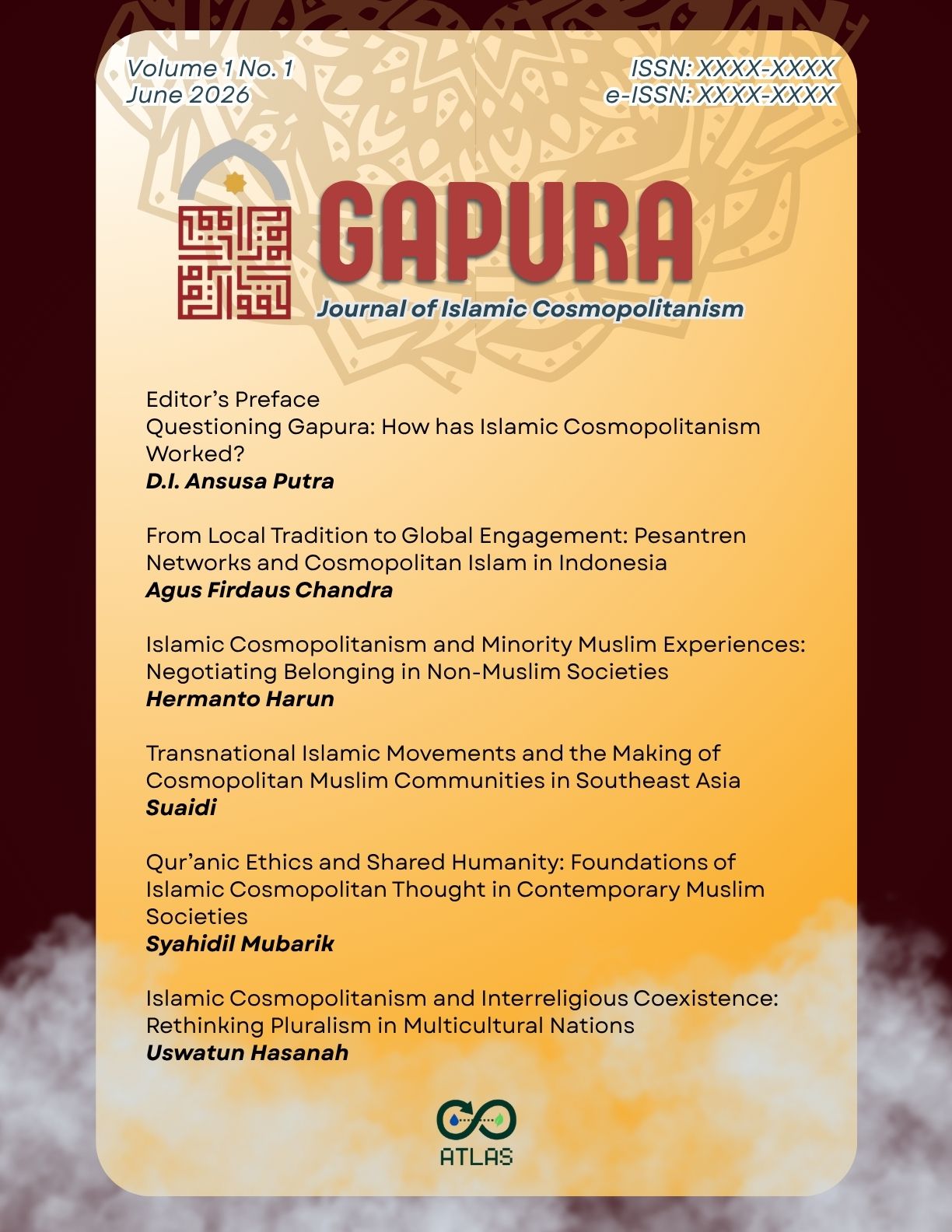
QURANIC ETHICS AND SHARED HUMANITY: RECONSTRUCTING ISLAMIC COSMOPOLITANISM IN A PLURAL WORLD
Keywords:
Quranic Ethics, Shared Humanity, Islamic Cosmopolitanism, Pluralism, Human DignityAbstract
The discourse on Islamic cosmopolitanism has attracted growing scholarly attention amid increasing religious diversity and global interconnectedness. Nevertheless, the ethical foundations of Islamic cosmopolitanism in the Qur’an remain underexplored. This article aims to examine how Quranic ethics can provide a normative framework for reconstructing Islamic cosmopolitanism through the concept of shared humanity. Employing a qualitative library research design, data were collected from selected Qur’anic verses, classical and contemporary exegeses, and scholarly literature on Islamic ethics and cosmopolitanism. The data were analyzed using thematic content analysis to identify key ethical principles relevant to human coexistence. The findings reveal that the Qur’an promotes shared humanity through the values of human dignity (karāmah), justice (ʿadl), compassion (raḥmah), mutual recognition (taʿāruf), and social responsibility. These principles form the basis of an inclusive Islamic cosmopolitanism that embraces diversity while encouraging dialogue and cooperation across communities. This study contributes to Islamic Studies by offering a Quranic ethical reconstruction of cosmopolitanism and demonstrates the continued relevance of Quranic ethics for fostering peaceful coexistence in plural societies.
References
Abdullah, A. H. (2025). Reconceptualizing peace through fiqh al-ta'ayush: Lessons from Islamic cosmopolitanism for contemporary political and moral uncertainty. E-Journal of Islamic Thought and Understanding, 8(2), 1–10. https://doi.org/10.24191/ejitu.v8i2.9054
Afsaruddin, A. (2009). The hermeneutics of inter-faith relations: Retrieving moderation and pluralism as universal principles in Qur'anic exegeses. Journal of Religious Ethics, 37(2), 331–354. https://doi.org/10.1111/j.1467-9795.2009.00389.x
Agli, M., Raki, A., Laklimi, A., Choubed, N., & Alzaidi, M. N. (2025). Coexistence and communication with the other in Islam: A civilizational framework for building common humanity. Journal of Cultural Analysis and Social Change, 10(2), 3343–3350. https://doi.org/10.64753/jcasc.v10i2.2103
Ali, M. B. (2022). Delineating the concept of human dignity in the Quran: Karamah al-insan as an antidote to religious conflicts and violence. Advances in Social Sciences Research Journal, 9(1), 220–235. https://doi.org/10.14738/assrj.91.11541
Aljunied, K. (2016). The cosmopolitan mosque. In Muslim cosmopolitanism: Southeast Asian Islam in comparative perspective (pp. 29–53). Edinburgh University Press. https://doi.org/10.3366/edinburgh/9781474408882.003.0002
An-Na'im, A. A. (2021). Decolonizing human rights. Cambridge University Press. https://doi.org/10.1017/9781108264921
Atie, R., Dunn, K. M., & Ozalp, M. (2017). Religiosity, attitudes on diversity and belonging among ordinary Australian Muslims. Australian Journal of Islamic Studies, 2(1), 1–15. https://doi.org/10.55831/ajis.v2i1.27
Dunn, K. M., Atie, R., & Mapedzahama, V. (2016). Ordinary cosmopolitans: Sydney Muslims’ attitudes to diversity. Australian Geographer, 47(3), 281–294. https://doi.org/10.1080/00049182.2016.1191132
Elmahjub, E. (2023). Artificial intelligence (AI) in Islamic ethics: Towards pluralist ethical benchmarking for AI. Philosophy & Technology, 36(73). https://doi.org/10.1007/s13347-023-00668-x
Fauzian, R., Sutikno, S., Munipah, M., & Hadiat, H. (2024). Islamic cosmopolitanism: Reuniting the socio-religio, religio-culture, and religio-politics of the present. Malaysian Journal of Islamic Studies, 8(2). https://doi.org/10.37231/mjis.2024.8.2.280
Hefner, R. W. (2020). Islam and covenantal pluralism in Indonesia: A critical juncture analysis. The Review of Faith & International Affairs, 18(2), 1–17. https://doi.org/10.1080/15570274.2020.1753946
Hefner, R. W. (2021). Islam and institutional religious freedom in Indonesia. Religions, 12(6), 415. https://doi.org/10.3390/rel12060415
Hefny, A. (2023). Freedom and pluralism in Islam: A cultural interpretation. Münster Journal for Islamic and Philosophical Studies, 2(1). https://doi.org/10.17879/mjiphs-2023-4618
Husairi, A., Syu'aib, K., & Kheiralla, M. I. (2024). Analysis of Pampeh law in Sarolangun customary documents from the perspective of Maqashid Sharia. Madania: Jurnal Kajian Keislaman, 28(2). https://doi.org/10.29300/madania.v28i2.5325
Khan, I., Elius, M., Nor, M. R. M., Yusoff, M. Y. Z. M., Noordin, K., & Mansor, F. (2020). A critical appraisal of interreligious dialogue in Islam. SAGE Open, 10(4). https://doi.org/10.1177/2158244020970560
Klaina, Mekki., Putra, D.I. Ansusa. (2024) Al-Tasāmuh or Tolerance In The Quran And Sunnah And Claims Of The Deniers, Vol. 7 No. 1 (2024), doi: https://doi.org/10.14421/lijid.v7i1.5367
Kurniawan, S., & Pulungan, J. J. (2025). Martabat kemanusiaan dalam Al Quran menurut Tafsir Al Azhar karya Prof Hamka. Ulumuddin: Jurnal Ilmu-Ilmu Keislaman, 16(1), 25–48. https://doi.org/10.47200/ulumuddin.v16i1.3125
Marsden, M. (2018). Islamic cosmopolitanism out of Muslim Asia: Hindu–Muslim business co-operation between Odessa and Yiwu. History and Anthropology, 29(1), 121–139. https://doi.org/10.1080/02757206.2017.1359587
Paul, J., & Criado, A. R. (2020). The art of writing literature review: What do we know and what do we need to know? International Business Review, 29(4), 101717. https://doi.org/10.1016/j.ibusrev.2020.101717
Putra, D.I. Ansusa (2022). Quran-Bible Validation In Contemporary Indonesia: Social Media, Religious Conversion, And Theological Debate. Khazanah: Jurnal Studi Islam Dan Humaniora, 20(1), 111–126. https://doi.org/10.18592/khazanah.v20i1.5541
Rane, H., Bargallie, D., & Meston, T. (2024). Mobilising a decolonial–Islamic praxis: Covenants in Islam and Muslim–Indigenous relations. Religions, 15(3), 365. https://doi.org/10.3390/rel15030365
Ritter, C. (2023). Understanding cosmopolitanism: A morphological approach. Journal of Political Ideologies. https://doi.org/10.1080/13569317.2023.2275040
Siddiqui, M. (2015). Hospitality and Islam: Welcoming in God's name. Yale University Press. https://doi.org/10.12987/yale/9780300211863.001.0001
Snyder, H. (2019). Literature review as a research methodology: An overview and guidelines. Journal of Business Research, 104, 333–339. https://doi.org/10.1016/j.jbusres.2019.07.039
Tho Seeth, A. (2023). The Indonesian “Cosmopolitan Islamic Intellectual” revisited: A focus on the continued prevalence of “cosmopatriotism” and the “West”. International Journal of Islam in Asia, 2(2), 114–143. https://doi.org/10.1163/25899996-20223005
Vaismoradi, M., Jones, J., Turunen, H., & Snelgrove, S. (2016). Theme development in qualitative content analysis and thematic analysis. Journal of Nursing Education and Practice, 6(5), 100–110. https://doi.org/10.5430/jnep.v6n5p100
Yusoff, A. M., Said, N. L. M., & Yabi, S. (2019). The meanings of mercy and its manifestations in Qur'anic legislation. Maʿālim al-Qurʾān wa al-Sunnah, 15. https://doi.org/10.33102/jmqs.v15i0.193
Zaduqisti, E., Mashuri, A., Zuhri, A., Haryati, T. A., & Ula, M. (2020). On being moderate and peaceful: Why Islamic political moderateness promotes outgroup tolerance and reconciliation. Social Compass, 67(3), 359–377. https://doi.org/10.1177/0084672420931204